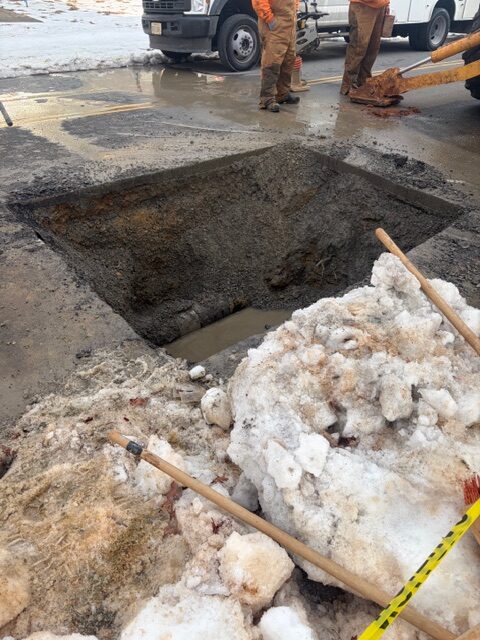
On Sunday morning, many students were hit with a reality when they went to brush their teeth, fill up their water bottle, or take a shower. Because of a water main break that occurred on campus, most buildings located off Market Street had no water access for several hours. Students received a text on Sunday at 11:34am that water services would be interrupted, and another text indicating it was restored at 2:49pm that same day.
It is not often thought about, but under most roads is a series of pipes that carry water into buildings. Sometimes, if you see blue lines marked on the roads, that indicates where the pipe is laid beneath. A water main break occurs when one of those pipes breaks suddenly. This can cause damage, resulting in cracks in the pavement from the pressure of the water pushing through it. Many main breaks go undetected until this point, because they remain underground until the break becomes large enough. Other breaks can create large geysers or cause a steady stream of water to break through the pavement, causing water to run down the street. This is what the campus witnessed on Sunday morning. Students reported seeing the small creek that runs through campus turn orange with the dirt that was pushed into it through this break. The dirt also left a similar presence outside the Wortman Complex.
The City of Salem Water Department are the ones who respond to issues like these. They make repairs on water infrastructure and treat drinking water for the City. I had the chance to speak with an employee who was on site working on the main break. He informed me that this was a large break, where a 10-inch diameter water pipe had previously broken within the past year. At the time, it split down the side of the pipe, so they placed a clamp on the pipe to fix it. A clamp hugs around the pipe almost like a glove, preventing the leak from coming out. It is a commonly used tool in the industry to fix main breaks. These clamps are reliable and normally ensure the leak stays contained; however, with the colder temperatures, the Salem Water Department assumes it failed. This malfunction was the cause for the eruption.
When a main break like this happens, it is not the break itself that causes buildings not to have water. During a break, buildings fed by the pipe may experience lower water pressure, or dirty water. Water access is cut off when the crew goes to fix the leak. They have to turn the water off at the street in order to effectively repair the pipe. It would be hard to do this under pressure, so they turn off the water. They complete this by turning valves at the end of pipes, that stops the water flow to specific streets. Most manhole lids you see have these valves underneath. Once the water stops flowing, they are able to begin repairs before they refill the excavated area and repave it.
Main breaks are more common in colder months, as water expands in small cracks and split pipes. The City of Salem Water Department employee said they have been experiencing many emergency main breaks this season, with some of them even happening off Main Street causing large traffic interruptions.
With this being said, it is important to keep in mind that this is a busy construction season for them so it is necessary to be patient with crews that work hard to ensure consistent water use if this happens again.
Kara Hopkins
News Editor