On Feb. 7th in Montgomery, Alabama, Roanoke College swept the award ceremony at this year’s annual Region 4
American College Theatre Festival; also known as “ACTF” for short. Three notable students in particular won astonishing
first place prizes in their respective categories, practically unheard of. This was a tiny department with a limited budget
against humongous universities with MFA programs across the entire southeast area of the country, and yet, Roanoke College managed to make a notable impression across them all.
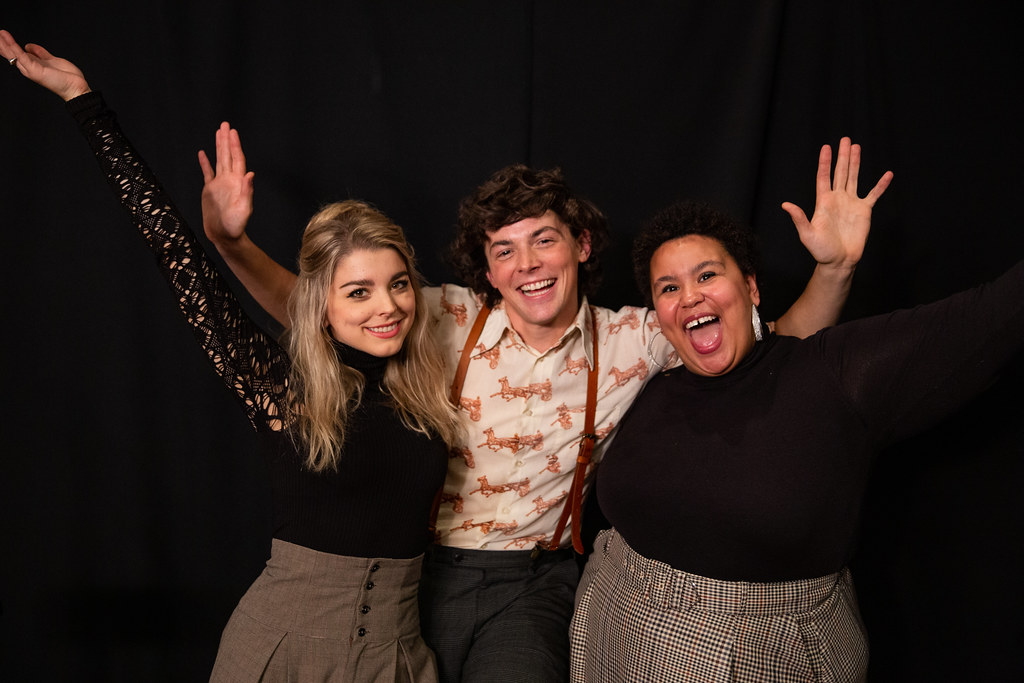
To celebrate this momentous occasion, I’ve had the pleasure of interviewing senior Kennedy Swineford, junior Bella Testerman, and junior Allison Dunnegan about their ACTF experience and theatric processes.
Junior Allison Dunnegan is a public health and sociology double major. Always wearing the best smile and an impeccable positivity to be around, she scored the National Fellowship
in Dramaturgy, first place Region 4 recipient. This was her very first time working on
dramaturgy, and out of dozens of every single university’s productions, earned the highest
mark. Here’s what she had to say in her recent interview:
Q: What were your first initial thoughts and feelings upon winning the national fellowship in dramaturgy? How would such a win impact your future?
“My first thought was, ‘this is not real.’ I definitely did not expect my name to be called. I went into the festival hoping to learn more about dramaturgy, research and collaborating with my peers, so I’m totally honored by it.
“For my future, I’d say this has really proved my love for theatre, dramaturgy, public speaking and research, all aspects I’d have to use in my career one day that I can apply to my future. I definitely want to keep pursuing this [theatre] throughout Roanoke however, or even longer.”
Q: What was your process towards doing dramaturgy for The Moors? Were there any specific strategies you used?
“First, I used my experience as an actor to remember what I wanted from dramaturgy, then used that to guide myself. After I spoke with my director to get a feeling for what sort of historical, dramaturgical aspects she wanted to include in the show. As I continued to research the things that interested me, I incorporated them in, researching stage blood and such. I did major research in the summer before the acting team came together in September, and once that clicked into place, I got actors to ask me questions that I included answers for in my research.”
Q: What’s your history/background with dramaturgy? How did it become your passion, and is it a potential career path for you?
“This was my first time doing dramaturgy, which is why it was so shocking. I’ve been doing theatre since I was five in a community theatre to keep me stimulated, however it slowly turned into something I’m extremely passionate about and truly love. It’s given me skills that I’ve used in every single one of my classes, jobs, internships that I’ll forever be grateful for.
“I say anyone and everyone should do theatre.
“For the future, I’d love nothing more than to have at least some kind of involvement in theatre. However, I love public health, and would like to see the two combined in a story telling format. I want to research and work with that, for it’s a goal of mine to seek one day.”
Q: How did your experience differ with this ACTF festival compared to last year?
“Last year I was in a completely different field. I was nominated for acting, thus I brought a scene and a monologue. With last year being my first festival, I didn’t know what to expect, but this time around I knew I wanted to do as much as possible.
“With dramaturgy, I got to do a lot more workshops and really ‘zero in’ on learning that craft. But I also knew I wanted to do more work with ten-minute plays, 48 hour challenges to write programs, and even work with a playwright. Each year you attend this festival, the more ways you find methods to get involved.”
Q: Did Roanoke College Theatre have an impact towards your growth in dramaturgy? If so, what are some examples?
“Yes, because theatre Roanoke is always very encouraging to try new things, and doesn’t shy away from being willing to have someone new and experiment. Just the fact that even though I’m not a theatre major, I’m able to be a part of productions is something I haven’t taken for granted.
“The professors explained to me how to do dramaturgy and were always available to questions I asked even during the summer, making it even more special. Overall, the welcoming atmosphere and the department being willing to have people try new things and support them is crucial.”
Q: What are your next steps after such an accomplishment?
“I’m looking forward to being in Romeo & Juliet this semester, and although we’re still in season selection for next year, I definitely look forward to those shows in any capacity. And from this experience, I know I definitely want to do dramaturgy, learn, and experience just as much as I possibly can as I enter my final year.”
Q: If you could talk to your younger self, what advice/statements would you tell her?
“I would tell her to continue to follow the joy, and don’t be afraid to take creative risks.
“It’s okay not to pick the ‘right’ option because whichever path you choose will be the correct one. I didn’t think I was going to do theatre here at Roanoke, but after finding so much joy in it my freshmen year, I knew I had to continue it. With the [theatre] community I’ve been involved with, it’s given me so much. I wouldn’t be where I am today without it.”
Q: Any closing comments or people who’d like to thank?
“I’d like to thank my parents for always being supportive, and would also like to thank my friends for being there for me and being my biggest supporters in my home away from home.
“Anyone considering theatre, just do it! Follow the joy it brings you, and you’ll never know what you might find.”
Zachary Bayers
Editor-in-Chief