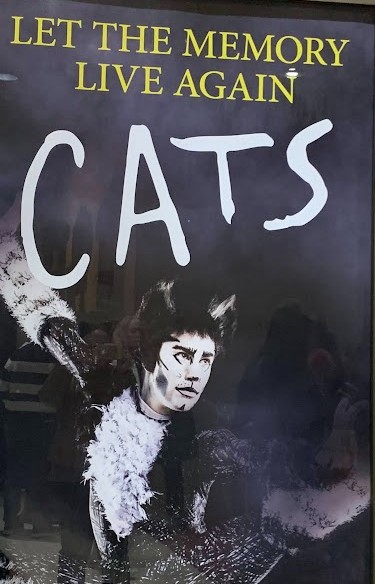
Some readers may remember one of my early articles about the controversy surrounding the Broadway musical Cats and my analysis of its various movie adaptations. As time has passed, Cats (2019) has faded from most people’s minds, though it still unfortunately dominates search results when looking for information or songs from the musical. Perhaps the collective disappointment with that film had an unexpected upside, because Cats: The Jellicle Ball, a new revival of the musical, has just begun previews on Broadway.
This revival is particularly interesting because the book has been rewritten while keeping the show’s original premise intact. The general plot, what little there is, remains the same, but the setting has shifted. Instead of a junkyard, the cats now gather at a drag ball. The flexible nature of the show allows for this reinterpretation, and the change offers a fresh and inventive take on the material. Notably, most of the cast members in Cats: The Jellicle Ball are people of color. While race is not a defining feature in a show where all characters are anthropomorphic cats, this casting choice influences the production in meaningful ways by incorporating elements of the performers’ cultures into their portrayals.
Another current Broadway revival, Chess, which I wrote about in October, also features a rewritten book. Jukebox musicals, which rely on collections of songs loosely tied together by a plot, often lend themselves to updates that reflect the era of the revival. Chess is one such musical, and its story tends to shift dramatically from production to production. Even shows with more substantial plots can undergo significant changes. Early revivals of Anything Goes, as well as its first two film adaptations, kept the basic storyline but frequently swapped character names, added songs from other Cole Porter musicals, removed numbers, and rearranged the show. It was not until the 1980s revivals that Anything Goes settled into the version audiences recognize today.
Some revivals use changes to make a statement about the contemporary world. The 2022 revival of 1776, for example, featured an entirely female or non-binary cast. In a show about the Second Continental Congress, which originally includes only two small roles for women, this casting choice highlighted themes of female empowerment and the often-overlooked contributions of women to American independence. Similarly, the 2018 revival of Company featured a gender-swapped cast, altering the characters’ genders rather than simply casting actors of different genders in the same roles. In Company, the lead character and their love interests were gender-swapped, which created a different commentary on the state of the world. Women face different challenges than men, so the subtle thematic implications shifted even though the words and much of the plot remained the same.
Of course, not all Broadway revivals undergo dramatic transformations. Most feature smaller adjustments, often in choreography tailored to the strengths of the cast. Every director aims to leave their mark on a show while preserving its core identity, and this balance is what makes each revival unique and meaningful.
Kathryn McElfresh
Staff Reporter