
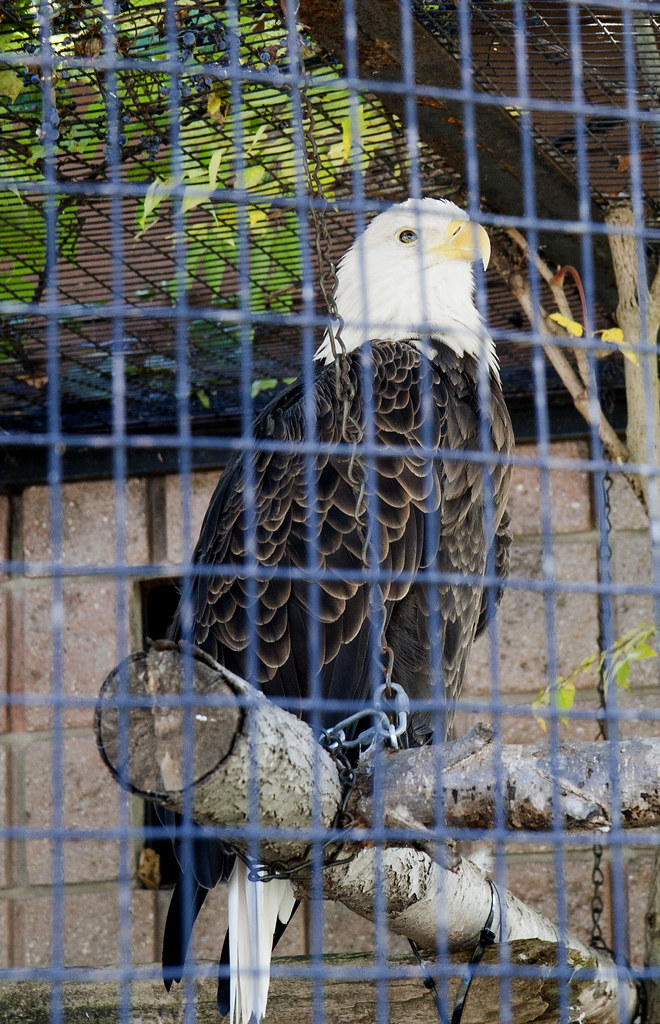
Last Summer I had the great privilege of being an intern at the Southwest Virginia Wildlife Center. One thing that has stuck with me since my internship was my interactions with birds; namely, raptors.
I have continued to follow stories from the center, and it was through them that I learned about Maggie, a bald eagle from Giles County who passed over a week ago. To get her full story, I contacted Kayla Short, who is the center’s social media manager, and works at the front desk. Due to her position, Short is often the first to get notice of new patients. Maggie’s story has blown up locally, garnering media attention from several sources. “As far as why the story took off, one part is that people love eagles,” Short said, adding, “national bird, they’re big and pretty.”
Short gave me the rundown of how Maggie ended up at the center. Maggie and her mate had been documented by local photographer and Giles County resident Dicy Howell for ten years. Howell found Maggie grounded and contacted the center for assistance. Later that day Maggie arrived at the center.
“In this case, her blood lead levels were so high that the machine could not actually give us a number. It just read high,” Short noted, adding that when levels are that high it is a death sentence for that animal. Maggie fought until the following afternoon when she sadly passed away. Due to her beloved status, Maggie’s death hit the wildlife community harder than other raptors.
I, however, had another raptor to inquire about. Last September, the center received a baby black vulture with high lead levels. The vulture was around nine months old, which Short commented on how it was a strange time for vultures as their parents raise their babies up to nine months. The vulture was grounded with the parents still feeding him. “He had grown up primary feathers, so he should be flying, but he was crazy small, and still had baby fluff,” she said. The blood test read high, and the x-ray revealed Metabolic Bone Disease. Metabolic Bone Disease causes weakened bones, loss of bones, or stunted growth. Short said that their best guess is that lead poisoning led to MBD and stunted growth of the baby vulture. “I was sad that that situation didn’t get more traction on social media,” Short recalled. Vultures tend to have a negative stereotype in the public eye, much like opossums until very recently.
Why is this happening? Lead enters wild spaces through ammunition and fishing tackle. Fish can ingest the tackle, or anglers will cut the line if they cannot reel the fish in. These fish are eaten by raptors and other animals, starting a chain of biomagnification of lead through the food web. Scavengers and omnivores like opossums and raptors are highly susceptible to lead poisoning. Scavengers ingest spent ammunition fragments from carcasses or offal piles left behind by hunters. Lead fragments are also taken up by plants to later be eaten by other animals. Short tells me that most patients at the center have levels of lead in their blood.
While we cannot remove the lead present in the environment, we can prevent adding more. You can use full copper ammo instead (not copper bullets with lead centers). Talking to the hunters in your life to make the switch are small steps to make change. For widespread change, legislation is needed. There is a pushback from making the switch from lead ammo to copper ammo by gun lobbyists that profit from the cheaper ammo. Seasoned hunters also present a kneejerk reaction, fearing that anti-gun campaigners are just using wildlife as a reason to “restrict the 2nd amendment”.
Maggie’s story is not unique. I felt inclined to share her story during this time of political and social unrest because she resembles the state of our country—a beautiful symbol suffering from the consequences of our actions. Maggie, as Short said, is popular due to her species and the status of the bald eagle. Obviously, however, bald eagles are not the only species affected by our negligence. Tackling our environmental issues is both complicated and quite simple, and it requires the public, as Americans, to take the time to reflect upon ourselves and how our world works. Can we eliminate lead from our environment? Probably not– but progress can start by the simple act of caring for the victims and placing more attention on their stories.
Iliana Martinez
Staff Reporter