Written by Madeline Wall, Staff Reporter
Thousands of people live, work, and play every day on Roanoke College’s campus, but many may not think about the energy and utilities they use while managing their busy lives. However, efforts from administration and environmental clubs on campus have made significant strides in prioritizing energy efficiency at Roanoke College. Upgrading lighting, water, and HVAC systems in campus buildings not only helps the college to save costs on utility bills, but it reduces unnecessary energy use that can worsen environmental conditions over time.
In the Spring of 2025, construction began to first start the construction of the Shaun McConnon Discovery Center and then begin the refurbishment of Crawford Hall. Both buildings opened this semester in the Fall of 2026, and both buildings were constructed with energy efficiency in mind.
First off, Tamara Lion, the Executive Assistant to the Senior Vice President of Finance and Operations noted that Crawford Hall’s remodeling has been built to save on energy costs, which in turn, prioritizes convenience for residents and prioritizes environmental conservation. For example, she specifically pointed out that the multiple water bottle filling stations on each floor are there to encourage reusable water bottle use instead of disposable beverages.
In addition, Crawford’s bathrooms are now equipped with motion-sensing faucets, so they do not dispense water unless they are activated. Similarly, the renovations installed motion-sensing lights in the halls and bathroom stalls in Crawford. Lion also pointed out that even the windows in the rooms and common areas have been replaced, and they are airtight, which means less energy is used to regulate the temperature in the building. Lastly, Crawford Hall has a central HVAC system, meaning that heating and cooling are controlled from a single location. The air and heat travel in small doses to each room, contrary to the old window air conditioning units where residents created spikes in energy use when they turned on their own heating and cooling.
Whether students and residents notice it or not, they use a lot of energy by living and working every day on campus, and the costs add up for the institutions that pay bills for their buildings. On average, university buildings use up to 60% more energy than standard office buildings because buildings on campus operate most hours of the day, most days a week. Targeting the places where unnecessary energy is used will decrease the energy bill over time, and it means that low energy buildings release little to no carbon emissions.
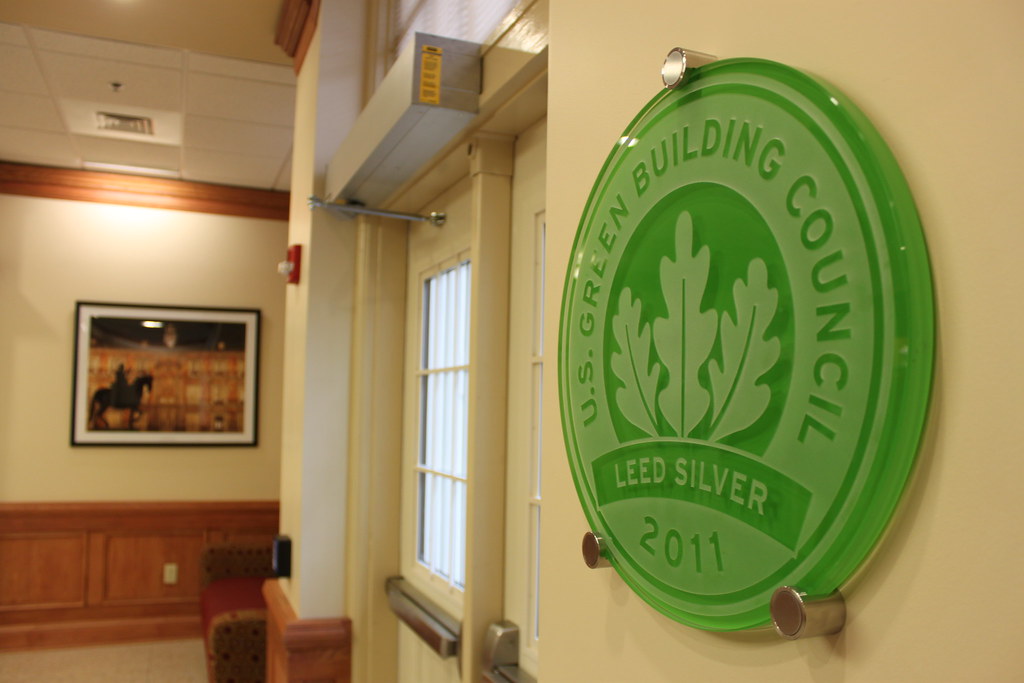
Furthermore, the Shaun McConnon Discovery Center has created strides in both student learning opportunities and energy efficiency on Roanoke College’s campus. Beginning during the construction process, Roanoke College’s administration prioritized energy optimization; the efforts paid off when the building achieved its goal of earning LEED Silver ranking.
The building is equipped with most of the energy efficient tools installed in Crawford Hall, but its unique architectural design allows an astonishing amount of natural light in the building, which reduces energy costs. In addition, the building has a partially vegetated roof, which serves as a soil layer covered with a waterproof membrane that blocks direct sunlight, prevents leaks into the building, and creates a cooler atmosphere.
These innovations and more led to the Shaun McConnon Discovery Center’s Silver LEED status. LEED stands for Leadership in Energy and Environmental Design, and it is a program developed under the United States Green Building Council that evaluates buildings based on their sustainability for students, faculty, and staff, and the environment, along with the building’s energy consumption. A Silver LEED ranking means that the Shaun McConnon Discovery Center uses 30% less energy than buildings without energy efficient tools.
Based on these achievements, Roanoke College has made strides in energy efficiency during the last couple of years. Continuing in this direction in other campus buildings will ensure less money spent on energy, less reliance on fossil fuels and carbon emissions, and less wasted energy from poor building insulation.
Conversations are already happening among Roanoke College’s environmental clubs, such as RC Sustain and Earthbound, about how to make campus more sustainable. These conversations include ideas like installing solar energy, implementing efficient transportation to and from campus, and refurbishing lighting in campus buildings. To share more ideas and to become a part of Roanoke College’s sustainability efforts, reach out to professors in the environmental studies department or to the environmental clubs on campus.